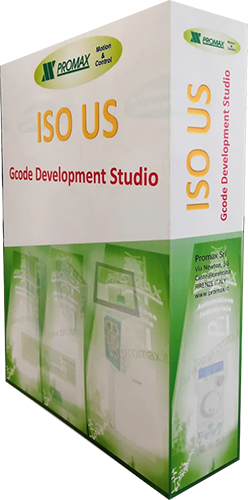
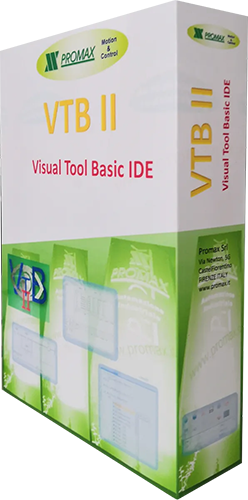
Visual Tool Basic IDE – R.A.D. Development Environment
Características
- Orientado a objetos
- Biblioteca de objetos
- Funciones integradas de control de movimiento
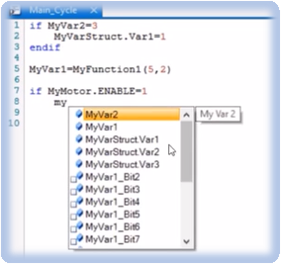
- Depuración de código completo con PASO a PASO
- Código nativo CPU
- Código multitarea
Interpolación
- Interpolación Lineal, Circular, Helicoidal
- eCAM
- Gear
VTBII es un entorno de desarrollo integrado para programación orientada a objetos en todas las plataformas. El entorno contiene en su interior todas las herramientas necesarias para desarrollar aplicaciones de una forma sencilla e intuitiva. La filosofía de VTB se basa en las últimas tecnologías RAD (Rapid Application Development) que permiten un desarrollo rápido de aplicaciones escribiendo una pequeña cantidad de código gracias a una enorme librería de objetos y funciones tecnológicas disponibles.
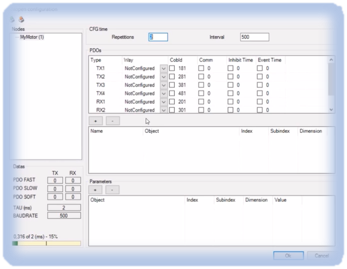
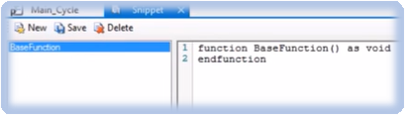
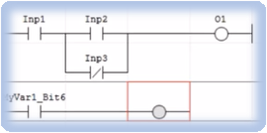
Implementando el código adicional se puede manejar cualquier tipo de aplicación industrial. VTB integra un lenguaje de alto nivel como BASIC MOTION LADDER, un lenguaje evolucionado, y una gestión gráfica de los ciclos de PLC más rápidos (I/O). Además del CANOPEN y ETHERCAT puede gestionar protocolos serie RS232/RS485 como MODBUS. La configuración del OPEN LINE CAN o EtherCAT se realiza de forma sencilla y controlada definiendo cualquier nodo como un objeto para ponerlo a disposición del entorno VTB. Potente movimiento de ejes que permite la gestión de cualquier tipo de máquina mediante funciones de interpolación CIRCULAR, VELOCIDAD LINEAL, LÍNEAS DE POTENCIA, PERFIL DE LEVA, etc.
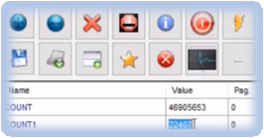
Su potente DEBUG permite controlar el funcionamiento de la aplicación de una ubicación remota.

Motion Control
| eCAM | YES |
|---|---|
| Gear | YES |
| Interpolation | Linear, Circular, Helical |
| Axis synchronization on the fly | YES |
Tipos de Variables
| Bit | from 0 to 1 on Char-Uchar-Int-Uint-Long |
|---|---|
| Char | from -128 to +127 |
| Unsigned Char | from 0 to 255 |
| Int | from -32768 to +32767 |
| Unsigned Int | from 0 to 65535 |
| Long | from -2.147.483.648 to +2.147.483.647 |
| Double | from 2.22507e-308 to 1.79769e+308 |
| Array | On all variables type excluding BIT |
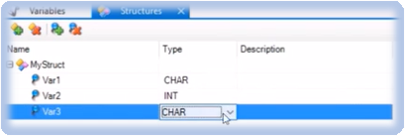
| Structure | On all variables type excluding BIT |
| Pointer | CHAR,UCHAR,INT,UINT,LONG,FLOAT,STRUCTURE |
| Delegate | Call Function by Address |
Gestión de Memoria
| Global | Visible from all Tasks |
|---|---|
| Private | Visible from single Tasks |
| Static | RAM with Battery |
| Fixed | Fixed Address |
| Functions | Like «C» con Argomenti e Parametro ritorno |
|---|---|
| Iterative Cycles | FOR, NEXT, EXITFOR, STEP,WHILE,LOOP,EXITWHILE |
| Conditional Cycles | IF,ELSE,ENDIF,SELECT,CASE,ENDSELECT |
| Logical and Mathematicali | All |
| Mathematical Functions | SIN,COS,SQR,TAN,ATAN,ASIN,ACOS,ATAN2,ABS,FABS |
Funciones del Sistema
| Timers Management | YES |
|---|---|
| String Management | YES |
| Memory Management | Alloc/Dealloc |
| RS232 Management | YES with custom protocol (RX Interrupt) |
| Ethernet Management | YES with custom protocol |
| ModBus RTU | YES by Object (RS232 or RS485) |
| ModBus TCP/IP | YES by Object |
| I/O Management | By Code or Ladder |
| CanOpen Management | YES |
| Ethercat Management | YES(CoE) |
Depuración
| Break Points | Only NG WARP |
|---|---|
| Step by Step | Only NG WARP |
| Variables Watch | All board Write/Read |
También te puede interesar…